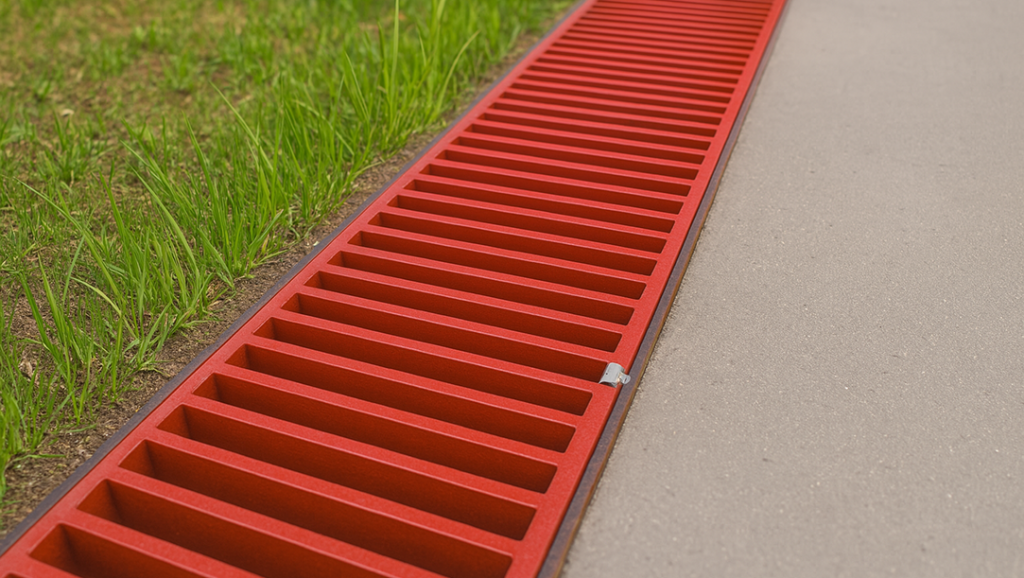
When surface water needs to be collected along a foundation, masonry opening, or other defined area, a trench drain provides a continuous drainage channel rather than relying on a single collection point. For builders and contractors, selecting a trench drain means considering more than the size of the channel. Material, dimensions, grate type, drainage capacity, installation conditions, and expected loads can all affect which configuration is appropriate for an application.
Steel trench drains are used in residential and light commercial construction for applications where surface water needs to be collected and directed to a drainage system. Understanding the basic components, available sizes, and installation considerations can help contractors evaluate their options before specifying a trench drain.
What Is a Trench Drain?
A trench drain is a linear drainage system designed to collect water along the length of a channel and direct it toward an outlet. Unlike a point drain, which collects water in one location, a trench drain creates a continuous collection area along a defined path.
A typical trench drain consists of a drain box or channel, a grate or covering, and components used to close, connect, or redirect sections of the system. Individual sections can also be combined to create longer drainage runs.
For foundation and masonry applications, trench drains can be used where water needs to be collected along a structure or construction area and directed away from the surrounding surface.
What Are Steel Trench Drains Used For?
Steel trench drains can be incorporated into a range of residential and light commercial construction applications. They are particularly useful where surface water needs to be collected across a longer area rather than at a single drain location.
Common applications can include:
- Foundation drainage
- Masonry construction
- Basement and below-grade areas
- Areas where water collects along a defined opening or surface
- Residential and light commercial drainage applications
The conditions around the drain are important when selecting a configuration. A drain installed in a pedestrian area may have different requirements than one located where vehicles, equipment, or other concentrated loads will pass over the grate.
Marshall Stamping manufactures steel trench drain systems for residential and light commercial applications. The systems are available in multiple widths and lengths, with steel and cast grate options for different installation and loading conditions.
Key Components of a Steel Trench Drain
Understanding the basic components can make it easier to compare trench drain configurations and determine what a project requires.
Drain Box
The drain box forms the main channel that collects water. Marshall Stamping offers steel drain boxes in 6-inch, 8-inch, and 12-inch widths.
Different configurations are available depending on the application and how the drain will connect to the surrounding drainage system. Reviewing the available dimensions is important before selecting a drain, particularly where installation space is limited.
Grate
The grate covers the top of the drain while allowing surface water to enter the channel. Marshall Stamping offers both steel and heavy-duty ductile iron grate options.
The appropriate grate depends in part on the conditions around the drain. Areas primarily exposed to pedestrian traffic may have different requirements than areas subject to vehicles or equipment.
End Plates
End plates close the ends of the drainage channel and can also accommodate certain drainage connections. Marshall Stamping offers solid end plates as well as end plates with a 4-1/4-inch opening for its trench drain configurations.
Connections and Fittings
Longer drainage runs can be created by connecting individual drain sections. Marshall Stamping’s trench drain sections bolt together, while tees, elbows, and jays are available for configurations that require changes in direction.
This allows the drainage system to be configured around the layout of the construction area rather than limiting the installation to a single straight section.
How Is Trench Drain Size Determined?
Trench drain sizing depends on the conditions of the application. Channel width is one consideration, but drainage area, expected water volume, slope, outlet capacity, available installation space, and anticipated loads should also be reviewed.
Marshall Stamping offers trench drains in 6-inch, 8-inch, and 12-inch widths. Standard section lengths vary by width, with 6-inch systems available in 1-, 4-, 5-, and 6-foot lengths and 8-inch and 12-inch systems available in 4-, 5-, and 6-foot lengths.
Individual sections can be connected to create longer drainage runs, allowing the overall system to accommodate different layouts.
The interior dimensions also vary by drain width. Marshall Stamping’s 6-inch system has a 4-1/2-inch box width, while the 8-inch and 12-inch systems have 6-1/4-inch and 10-1/4-inch box widths, respectively.
Drainage capacity is another consideration. Published Marshall Stamping specifications list approximate flow rates at a 1% slope of 6.5 gallons per second for the 6-inch trench, 15.7 gallons per second for the 8-inch trench, and 32.4 gallons per second for the 12-inch trench.
These figures provide product information for comparison, but the appropriate drain should be selected based on the actual conditions and requirements of the installation.
Steel vs. Cast Grates
The grate is another component to consider when selecting a trench drain.
Steel grates can be used for a variety of residential and light commercial applications. For areas where greater load capacity is required, Marshall Stamping also offers heavy-duty ductile iron cast grates in 6-, 8-, and 12-inch configurations.
The expected use of the surrounding area should guide this decision. Pedestrian areas, vehicle-accessible areas, and locations exposed to equipment can place different demands on the grate.
Marshall Stamping publishes load information for its welded and cast grating, including maximum allowable loads based on contact area. The published ratings also specify installation conditions, including continuous support and concrete encasement around the trench drain.
Contractors should review the current product specifications and applicable installation requirements when selecting a grate for an area subject to vehicle or concentrated loads.
Foundation Drainage and Trench Drain Placement
Placement plays an important role in any drainage application. A trench drain needs to be located where water can enter the channel and move toward the intended drainage connection.
For foundation and masonry applications, contractors should consider the location of the drainage area, surrounding construction, available slope, and connection to the larger drainage system. The drain also needs to be installed at the appropriate elevation for the intended drainage path.
Planning the drain location before surrounding concrete or masonry work begins can help ensure that the channel, grate, and outlet are properly incorporated into the finished construction.
Other site conditions may also affect the installation. Project plans, applicable building requirements, drainage requirements, and manufacturer specifications should all be considered when determining the appropriate placement and configuration.
Trench Drain Installation Basics
Trench drain installation varies based on the product, site conditions, and surrounding construction. Before installation, the drainage location, required dimensions, elevation, slope, and outlet connection should be established.
The installation area is then prepared to accommodate the drain and surrounding construction. Individual drain sections are positioned and connected according to the manufacturer’s requirements, with the system aligned along the intended drainage path.
Once the drain is properly positioned and supported, the surrounding concrete or masonry construction can be completed as required for the application. Proper support is important to maintain the position of the drain and accommodate the loads expected in the finished installation.
Marshall Stamping’s published load ratings specify continuous support and concrete encasement on both sides and the bottom with 4 inches of 3,000 psi concrete for the listed load ratings.
Because installation conditions vary, contractors should review the applicable product documentation and account for project-specific requirements before installation.
What Should Be Considered When Selecting a Trench Drain?
Before selecting a trench drain, contractors should review several aspects of the application:
Application: Consider where the drain will be installed and how the surrounding area will be used.
Drain width: Evaluate the required drainage capacity along with the available installation space.
Drain length: Determine the total length of the drainage run and how individual sections will be connected.
Grate type: Consider whether the area will be exposed to pedestrian traffic, vehicles, equipment, or other loads.
Drainage capacity: Review expected water volume, slope, drainage area, and outlet configuration.
Installation: Check the manufacturer’s requirements for support, connections, concrete encasement, and surrounding construction.
Project specifications: Confirm that the selected configuration meets applicable project and construction requirements.
Reviewing these factors before ordering can help ensure the selected trench drain fits both the physical layout and intended use of the application.
Marshall Stamping Steel Trench Drains
Marshall Stamping manufactures steel trench drain systems for residential and light commercial construction applications. The product line includes 6-, 8-, and 12-inch drain widths, multiple standard lengths, steel and cast grate configurations, end plates, and components for creating continuous or directional drainage runs.
The steel drain boxes are coated inside and out with red corrosion-resistant paint. Steel grate systems use stainless steel clips and screws to secure the grates in place.
For contractors specifying trench drainage, the available dimensions, components, flow information, and load data provide the information needed to evaluate different configurations for a project.
Review the Marshall Stamping Trench Drains product information for current specifications, or contact Marshall Stamping to discuss the requirements of your application.
Frequently Asked Questions About Trench Drains
What is a trench drain?
A trench drain is a linear drainage system that collects surface water along a channel and directs it toward an outlet or larger drainage system.
What are trench drains used for?
Trench drains are used to collect and redirect surface water in applications such as foundation drainage, masonry construction, basement areas, and residential and light commercial construction.
What sizes do trench drains come in?
Marshall Stamping offers trench drains in 6-inch, 8-inch, and 12-inch widths. Standard section lengths vary by width, and individual sections can be connected to create longer drainage runs.
How is trench drain size determined?
Trench drain sizing depends on factors such as drainage area, expected water volume, slope, available installation space, outlet capacity, and the requirements of the application. Product specifications should be reviewed when selecting a configuration.
Are steel or cast grates better for trench drains?
The appropriate grate depends on the application. Steel grates can be used in residential and light commercial applications, while heavy-duty ductile iron grates are available for applications requiring greater load capacity.
How are trench drains installed?
Installation depends on the product and project conditions. Generally, the drainage location and dimensions are established, the installation area is prepared, the drain is positioned and connected, and the surrounding concrete or masonry construction is completed according to the manufacturer’s requirements.
Can trench drain sections be connected?
Yes. Marshall Stamping trench drain sections are designed to bolt together for continuous runs. Tees, elbows, and jays are also available for configurations that require changes in direction.